
FROM FIRST INQUIRY TO THE RIGHT NEXT STEP
Law Firm Intake Consulting
Find the opportunities that disappear inside intake. We review calls, missed inquiries, routing, qualification, follow-up, attorney handoffs and retainer completion, then turn findings into corrections your team can operate.
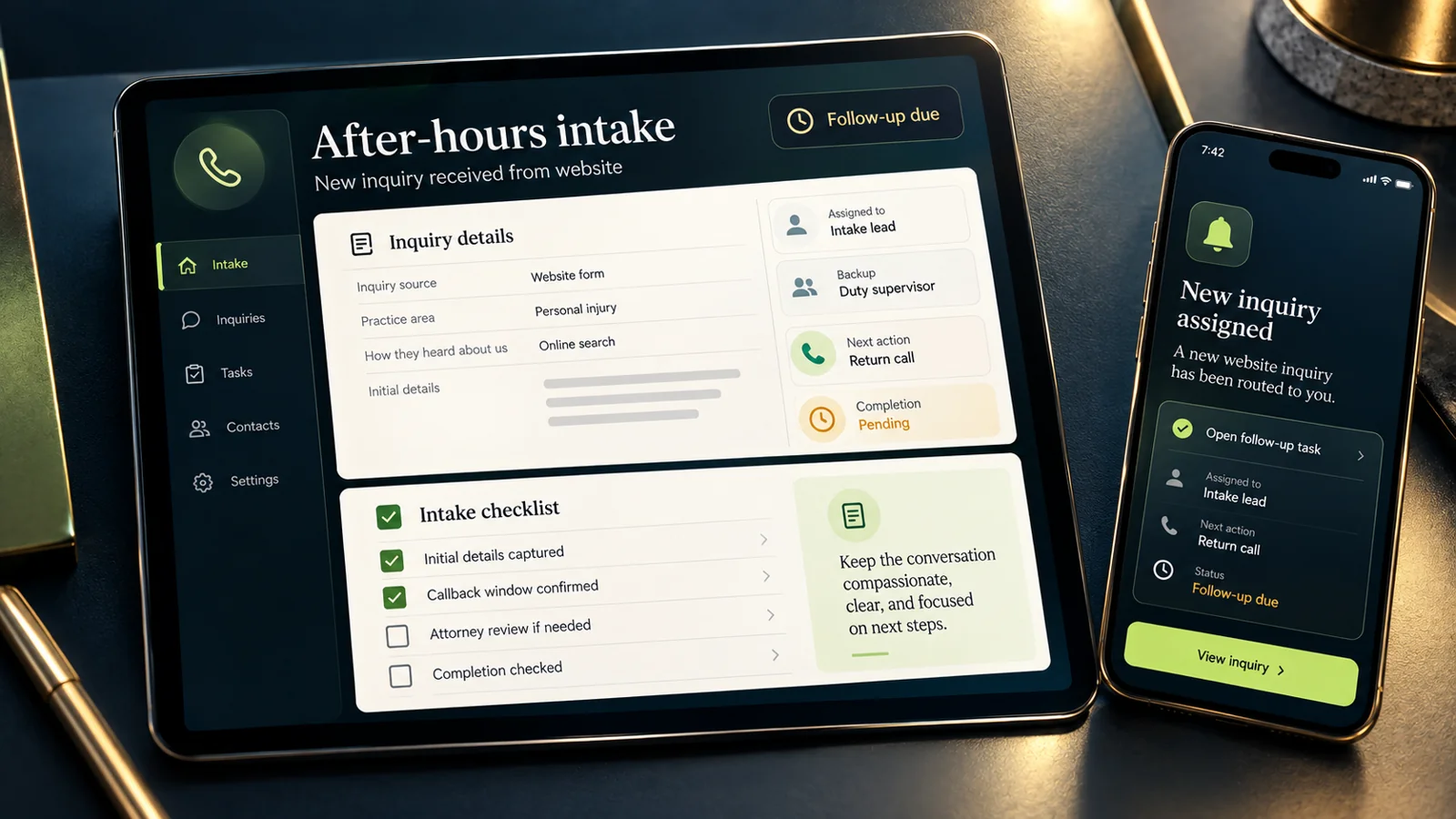
THE WORK, MADE CONCRETE
Where does the next qualified inquiry lose momentum?
We turn missed calls, unclear ownership and incomplete follow-up into specific corrections your intake supervisor can manage.
HOW WE EXECUTE
Trace the inquiry
We review authorized call records and follow-up history across reached, unreached, attorney-review and unsigned-retainer stages.
The firm approves access. Gadient diagnoses; the intake supervisor validates daily workflow.
What you receive
Stage map and ranked gap register
How we check it
Every finding refers to a specific observable breakdown.
Scope, access and responsibilities are agreed for your firm. This describes our service process, not a claim of a particular client outcome.
Agree on the review, the changes and the owner.
A review-only engagement delivers findings and an action plan. When implementation is included, we coordinate the agreed changes, prepare guidance and test the handoffs with the responsible staff or technical provider. Configuration, training and ongoing review are named in scope rather than assumed.
Swipe or scroll the table sideways to view every column.
For a wider diagnosis, compare the law-firm marketing audit.
An after-hours inquiry needs more than an alert.
Swipe or scroll the table sideways to view every column.
Apply the stages and controls in our PI intake optimization guide.
An inquiry captured is only the beginning.
Your reports may show leads arriving while the team struggles to reach them, qualify them, or move them to a signed agreement. A fast acknowledgment does not establish that a prospective client had a useful conversation.
We work with owners and intake leaders to understand where progress breaks down. The review considers people, coverage, rules, training, and technology together. Each finding leads to a specific operational decision.
Follow the common handoff gaps in where wanted cases get lost in intake.
Measure the steps that lead to a signed case.
Agree on stages that reflect the firm’s actual process. A personal injury inquiry may need legal review before an agreement is offered. Other practice areas may require a consultation first. Track stage timestamps, owners, and reasons for closure.
- Captured: did the inquiry reach the correct record and responsible queue?
- Contacted: did a human establish a two-way conversation?
- Qualified: does it meet the firm’s approved case-acceptance criteria?
- Advanced: is a consultation, attorney review, or agreement the next step?
- Signed and handed off: is the agreement complete and the matter assigned?
Make coverage and follow-up dependable.
Review missed and abandoned calls, after-hours inquiries, language needs, staff availability, and backup routing. For every open inquiry, the team should be able to identify the last action, next action, due time, and owner.
The firm should set response and follow-up expectations based on its audience, staffing, permissions, and observed outcomes. Compare the rules with actual records. An ambitious policy that is not staffed does not create reliable coverage.
Keep phone, text, email, and chat in one conversation.
A person who submits a form and later calls should not have to begin again. The team needs access to the relevant conversation history, contact preferences, and next step.
Define how channels connect to the lead record, when automation pauses for a reply, who takes over, and what happens if delivery fails. Sending a text is not proof of successful contact. The workflow should honor consent, opt-outs, and the firm’s requirements for sensitive information.
For scoped implementation and maintenance, explore AI intake assistants and managed follow-up workflows.
Translate these handoffs into vendor questions with the PI software decision center.
The omnichannel intake guide explains how ownership and conversation history should carry across channels.
Surface the exceptions that ordinary reports hide.
Daily management needs a view of the inquiries that require attention. The consulting work can define that view and the escalation rules; the firm assigns the manager who acts on it.
- Unassigned leads and overdue next actions.
- Messages that failed and calls without a completed next step.
- Wanted cases waiting for attorney review.
- Missed consultations or agreements awaiting signature.
- Duplicate records, inconsistent statuses, and unclear decline reasons.
Use the intake follow-up audit to check open records, routing, and overdue actions.
Understand why the right prospects do not sign.
Separate unsuitable matters from wanted cases lost to no contact, delay, another firm, unresolved concerns, or a difficult next step. Review examples behind the numbers before deciding whether the issue is training, capacity, process, or technology.
The client experience also matters: clear language, useful instructions, an understandable handoff, and staff who can explain what happens next. A higher attempt count alone does not demonstrate a better intake experience.
Give the team a practical improvement plan.
Depending on scope, the work can produce a lead-stage map, sample-based findings, routing and follow-up requirements, an exception-report specification, and a prioritized action plan. Implementation responsibilities are named explicitly.
Evaluate changes against the baseline using successful contact, qualification and signing rates, queue age, and completion of next actions. Use consistent populations and allow outcomes time to develop. Daily staffing, legal evaluation, and technical administration remain assigned to the appropriate firm or provider owners.
Explore the intake review with assigned actions.
Turn the intake review into a state-based operating plan.
Never contacted, callback requested, intake incomplete, and retainer unsigned are different operating situations. The Lead-to-Signed Case framework gives each a next action, responsible person, due time, permitted channel, and exit rule. That makes the findings from an intake review actionable.
An implementation scope can include stage definitions, staff responsibilities, workflow configuration, handoff tests, and an exception-review cadence. Begin with a bounded queue and expand only when the team can operate it reliably. Our anonymous implementation study shows the proposed design and acceptance tests without claiming unverified results.
Explore our Lead-to-Signed Case operating framework.
Inspect the proposed workflows and tests in an anonymous PI intake implementation case study.
COMMON QUESTIONS
Before we talk.
Do you replace our intake team?
The starting point is to improve the existing operation with its leader. Staffing, supervision, training, and technical implementation responsibilities are agreed in scope.
Can this work with our current CRM and phone provider?
Review the capabilities and actual usage first. Define the workflow and reporting requirements, then decide which configuration or integration changes are justified.
Can AI handle follow-up?
Automation can support routine steps when permissions, escalation, and human ownership are clear. Evaluate completion and errors, and retain attorney responsibility for legal decisions.
YOUR NEXT MOVE
See where your intake process needs attention.
Start with your firm's goals, current structure, and the decision you need to make.
856-357-3540