
CONNECT INVESTMENT TO THE OUTCOME
Law Firm Marketing Attribution & Reporting
Bring campaign, call, intake, and signed-case reporting into a consistent view. See what is working, where information is missing, and which decisions the evidence can support.
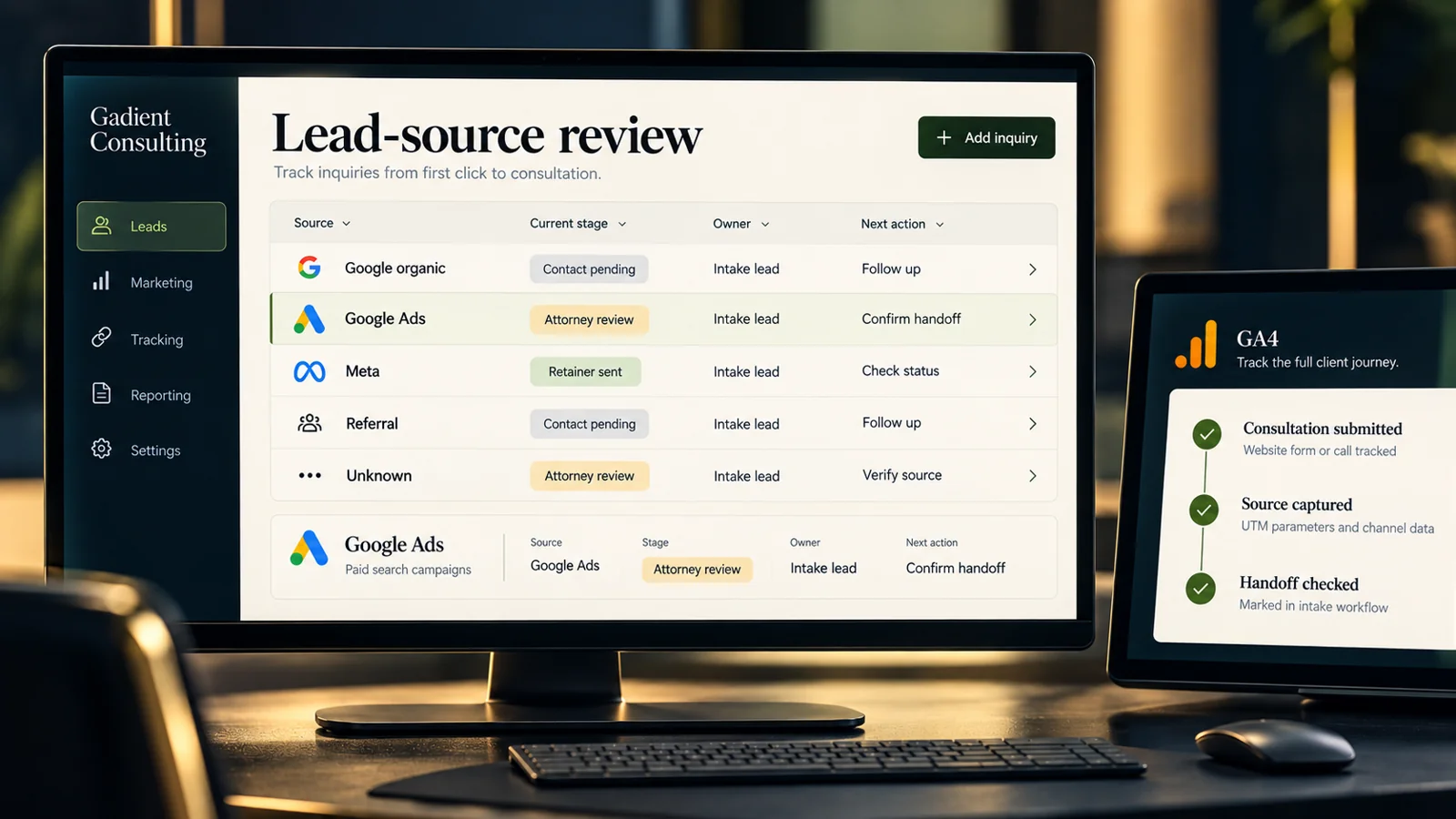
THE WORK, MADE CONCRETE
Can your reporting explain the next budget decision?
We connect source evidence, inquiry records and case outcomes into a reporting process leadership can actually use.
HOW WE EXECUTE
Define the record
We agree on source taxonomy, inquiry identity, case stages, dates and the difference between reported and verified source.
Gadient defines reporting requirements with intake and marketing owners.
What you receive
Field dictionary and source-evidence inventory
How we check it
Unknown and conflicting sources remain visible rather than being assigned by guesswork.
Scope, access and responsibilities are agreed for your firm. This describes our service process, not a claim of a particular client outcome.
- Qualified opportunity
- Signed case
- Matter and fee outcomes
Keep unknown sources and unresolved records visible.
Every agency has a report. You still cannot tell what works.
An advertising platform records a conversion. Call tracking records a conversation. Intake records a lead. The firm records a signed case. These can describe different events, populations, and time periods.
We help owners and operators establish the reporting requirements that connect those records. The aim is to make marketing decisions more defensible and give the people doing the work a shared view of performance.
A reporting specification, a reconciled baseline and accountable fixes.
We define the source map, stage and cost dictionary, reconciliation checks, shared scorecard and reporting review. Each gap receives an owner and acceptance test. We document which system supplies each field and how the report connects an inquiry to the firm's signed-case milestone.
Your intake and matter owners maintain statuses and outcomes; finance confirms spend and cost definitions. The authorized system administrator or technical partner implements agreed field mappings, permissions and connections. Gadient coordinates requirements and validates the resulting report against permitted records. We test the required connections and record handoffs before relying on them.
- Deliverables: source-to-outcome map, metric dictionary, sample-record reconciliation, prioritized correction register and management report.
- Acceptance: duplicate treatment, unknown-source handling, event dates and totals are explained before the report informs budget changes.
- Ongoing reviews: compare like cohorts, investigate exceptions and record the spending or management decision supported by the evidence.
Follow one inquiry through the report.
We follow each inquiry through its lifecycle, deduplicate records and retain stage timestamps. The report shows the original inquiry period alongside the signature period. When a missing source is recovered, we retain the evidence and change history.
Swipe or scroll the table sideways to view every column.
Compare the record design with our attribution report.
Agree on the event before comparing the number.
Define unique inquiry, successful contact, qualified or wanted case, agreement offered, signed case, and active matter. Establish who updates each stage and where the record is maintained.
- Document treatment of duplicates, spam, reopened leads, and referred matters.
- Distinguish original source, later touches, and self-reported source.
- Keep unclear sources visible instead of forcing them into a channel.
- Name the cost scope: media only or the agreed broader acquisition costs.
The distinction is illustrated in why marketing reports disagree.
Connect the records and explain the differences.
Review how calls, forms, chat, referrals, and campaigns enter the lead system. Identify which record links to the signed case and how source information survives the handoff.
The work can produce a source map, metric dictionary, reconciliation requirements, and a prioritized list of data fixes. CRM and technical partners are assigned implementation responsibilities. Changes should be tested against sample records before leadership relies on the report.
Compare outcomes at a fair point in time.
Some cases sign after the month in which the inquiry arrived. Dividing this month’s spending by this month’s signed cases is a period-efficiency view; it may not measure acquisition cost for the same group of people.
A cohort report follows inquiries from a defined period and shows their progress. Compare cohorts at similar maturity and distinguish unresolved opportunities from losses. Use projected fees and collected fees as separate business measures.
Apply the same timing discipline when measuring cost per signed case.
Make confidence in the data part of the report.
A polished dashboard cannot resolve missing information on its own. Report unknown sources, unmatched outcomes, duplicated records, stale statuses, and material differences between systems.
Assign owners to improve those inputs. Leadership can then understand whether a spending decision rests on a strong pattern, an incomplete signal, or a question that still needs investigation.
Use the unknown lead-source investigation process to recover supported sources without forcing attribution.
Inspect how unknown sources remain visible in the attribution report.
Use attribution for the question it can answer.
Attribution describes how recorded outcomes receive credit under a model. It does not establish that every credited case would disappear if a channel stopped.
When conditions support it, a defined experiment can help assess additional contribution. The test needs an appropriate design, sufficient information, and a clear decision rule. Avoid claiming perfect attribution or treating a platform’s return metric as the entire firm’s economics.
Turn reporting into a decision process.
The agreed scope can include a baseline assessment, measurement requirements, coordination with providers, and recurring performance reviews. It should identify what we lead and what the internal team or technical partner implements.
A useful review connects target, actual result, gap, likely cause, owner, and next action. The sample workbench shows how an attribution issue becomes an operational assignment and then a better decision.
Turn approved reporting tasks into managed AI and automation workflows while preserving source evidence and human review.
When software limits the reporting process, use the PI software comparison and demo checklist.
Turn the reconciled numbers into decisions with a monthly marketing review.
Connect source evidence to a consistent intake cohort.
The Lead-to-Signed Case framework keeps acquisition source, contact, qualification, signature, and onboarding connected through the inquiry record. Define which system is authoritative for each event and reconcile the permitted reporting data with those records.
This supports a more useful budget decision: whether an observed gap reflects source quality, a missing next action, a delayed decision, or incomplete measurement. Keep cost scope, open opportunities, source confidence, and observation cutoff visible. A signed case is not collected fees or profit.
Explore our Lead-to-Signed Case operating framework.
Inspect the proposed workflows and tests in an anonymous PI intake implementation case study.
COMMON QUESTIONS
Before we talk.
Can this cover calls, forms, referrals, and chat?
The measurement design should cover the sources your firm actually uses. The implementation depends on available records, permissions, and the capabilities of the selected systems.
Can we get perfect attribution?
Some journeys will remain incomplete or uncertain. The objective is reliable definitions, better reconciliation, visible gaps, and evidence appropriate to the decision.
Should ad platforms optimize for signed cases?
Evaluate the available downstream events, data quality, timing, volume, and applicable requirements with the responsible technical and legal owners. The right signal depends on the firm and account; a change should be validated before relying on it.
YOUR NEXT MOVE
Make your marketing reports useful for the next decision.
Start with your firm's goals, current structure, and the decision you need to make.
856-357-3540