
BUILD · INTEGRATE · DEPLOY · MANAGE
AI Agents & Automation for Law Firms
AI implementation that does useful work inside your firm. Gadient Consulting designs, integrates, deploys and manages AI assistants around clear responsibilities, human handoffs and measurable performance.
THE WORK, MADE CONCRETE
Who owns the agent after it goes live?
We create, integrate, deploy and manage AI assistants with defined responsibilities, tested human handoffs and ongoing quality review.
HOW WE EXECUTE
Scope the job
We identify one worthwhile workflow, approved questions, permitted data, exception paths and the human responsible for escalation.
Gadient designs the workflow; the firm approves policies and access.
What you receive
Workflow map and permission requirements
How we check it
The agent’s responsibilities and prohibited actions are explicit.
Scope, access and responsibilities are agreed for your firm. This describes our service process, not a claim of a particular client outcome.
- Assist
Collect approved information and answer process questions.
- Hand off
Route exceptions to a person with the conversation context.
- Verify
Confirm the record and next owner. Flag incomplete tasks for review.
Start with the work the firm needs done.
For an established personal injury firm, an unfinished task can pass through several systems and still have no clear owner. An inquiry arrives after hours, a consultation needs confirmation, or a manager spends a morning assembling information that should already be available. Those are concrete starting points for an implementation engagement.
We create, integrate, deploy, and manage AI bots and automated workflows around an agreed operating requirement. A bot may interpret a question or prepare a response. A rules-based workflow may be the better choice for a reminder, routing rule, or required approval. We choose the approach around the task, including where a person should remain responsible.
The engagement is designed for owners, managing partners, COOs, and marketing leaders who need implementation ownership. It can stand alone or sit inside a broader fractional CMO engagement connecting demand, intake, software, and team performance.
Connect this work to fractional CMO leadership for law firms.
Five practical uses to evaluate.
We build the workflow around your systems, approved information, access permissions and team capacity.
- Intake assistance: collect initial contact details and a firm-approved description of the inquiry, answer approved process questions, route it to the appropriate queue, and offer available consultation times. A request for legal advice or a case decision goes to the designated person.
- Follow-up: identify an uncontacted inquiry, prepare or send an authorized follow-up, record the outcome, and create a staff task if contact remains incomplete. Appointment reminders and requests for missing information follow the firm’s approved timing, consent, and stop rules.
- Internal knowledge: help staff locate current procedures, intake scripts, training material, and operating guidance in an approved knowledge set. Answers should identify their source and send uncertain or conflicting guidance to the responsible manager.
- Marketing and reporting: organize campaign and intake information, flag missing source fields or inconsistent totals, and prepare a review brief. People validate the findings and decide what changes to make; an assistant should not invent an attribution source to fill a blank.
- Connected workflows: carry an authorized task across the CRM, case-management system, phone, email, or messaging tools. For example, a confirmed consultation can update the correct record and create an assigned preparation task, subject to available integrations and permissions.
Compare the telephone workflow choices in our Bland AI versus ElevenAgents intake guide.
Define the intake process first through law-firm intake consulting.
From a worthwhile use case to a controlled launch.
Implementation needs a defined sequence, with a decision to continue or stop at each stage. We agree on the deliverables and responsibilities before building.
- Assess: map the current workflow, volume, delays, exceptions, and staff effort. Select a bounded task with a measurable starting point, useful upside, and a practical human fallback.
- Define: document the agent’s job, prohibited actions, source information, success metrics, access permissions, approval points, and accountable firm owner. Agree on what counts as a completed task.
- Build: select suitable platforms and configure the assistant or workflow. Establish approved instructions, knowledge sources, routing rules, and a record of configuration changes.
- Integrate and test: verify field mappings, record identity, permissions, and writes to the correct system. Test ordinary requests and failures such as a disconnected integration, ambiguous answer, duplicate inquiry, or unavailable staff member.
- Pilot and train: release to a limited workflow, channel, or team with agreed acceptance criteria. Train staff to review output, take over a conversation, report a problem, and pause the workflow.
- Manage and improve: review quality, resolve exceptions, maintain integrations and approved information, monitor usage costs, and report performance. Expand only after the pilot meets the agreed standard.
Before choosing a pilot, use the free PI firm AI readiness checklist and PDF worksheet.
For product evaluation criteria, read our legal AI buying guide for personal injury firms.
See the evaluation sequence applied to a broad legal-work platform in our Harvey AI pilot guide for PI firms.
An after-hours inquiry that still has an owner.
An intake assistant collects the approved initial information, explains the firm’s consultation process, and offers scheduling only when calendar access and rules support it. It records the inquiry in the agreed intake system and assigns the next action to a person or queue.
If the person asks whether they have a case, describes an urgent concern, supplies information outside the approved scope, or requests a human, the assistant follows the firm’s escalation instructions. It does not accept or reject representation, assess legal merits, or promise an attorney response time the team cannot support.
A failed record update is not a completed handoff. The pilot must show how the failure becomes visible, where the inquiry is safely retained under the agreed policy, and who reconciles it. A fallback contact route remains available when the automated path cannot complete the task.
A useful go/no-go rule: do not expand a workflow until the team can identify incomplete tasks, take over exceptions, and verify the result in the system of record.
AI implementation: from an after-hours inquiry to a verified handoff.
Swipe or scroll the table sideways to view every column.
Inspect the proposed handoffs in our labeled design-stage intake case study.
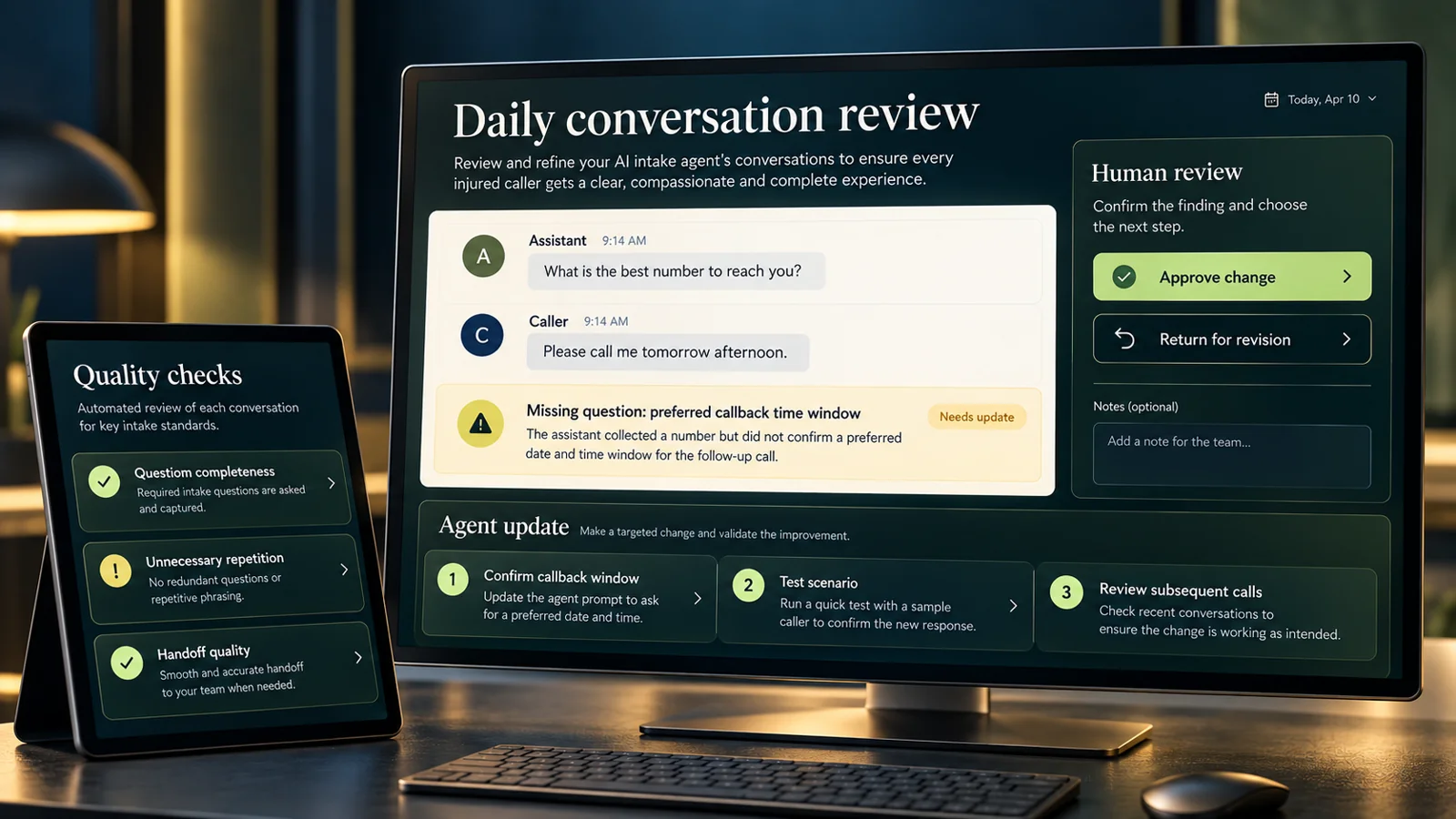
Daily review informs human-approved improvements.
As part of our managed voice-agent service, we build review bots that analyze transcripts daily for missed intake questions, repetitive behavior and sentiment signals. They produce flagged exchanges, findings and recommendations for a human to evaluate. Sentiment is an imperfect review signal, not a definitive judgment about a caller.
After approval, we refine agent instructions, approved knowledge or workflow rules, run the relevant scenarios again, and monitor subsequent calls. We improve the agent configuration and track question completeness, repetition, handoff quality and staff review effort across subsequent calls.
Access, transcript retention and permitted review data are agreed with the firm. We limit exposure of confidential information and keep legal and case decisions with designated people. Review coverage, incident handling and support responsibilities are written into the management scope.
Launch is the start of ownership.
An assistant can become unreliable when a script changes, a staff member leaves, a permission expires, or an integration behaves differently. Ongoing management is a substantial part of this service. We agree on what Gadient Consulting monitors and maintains, what your firm approves, and who responds when something needs attention.
The management plan includes conversation and output review, error monitoring, updates to approved knowledge, integration maintenance, escalation handling, usage-cost review, and performance reporting. Review frequency, support coverage, incident priorities, and response expectations belong in the engagement scope. Do not assume an always-available bot means around-the-clock human support.
We maintain a change record and test material revisions before broader release. Your firm designates an operational owner and the people authorized to approve legal content, communication policies, and sensitive changes. The handover plan identifies accounts, configuration documentation, access removal, and export options if the engagement ends.
- Review a defined sample of completed conversations and tasks, plus flagged exceptions, for accuracy, appropriate language, and correct routing.
- Track unresolved errors and escalations through closure, including the staff owner and next action.
- Keep procedures, scripts, staff assignments, and approved answers current with firm approval.
- Inspect usage changes and cost limits, then decide whether to refine, expand, pause, or retire a workflow.
Separate the build from ongoing ownership.
A focused after-hours implementation scope can cover one approved inquiry route, its receiving system, configured assistant, failure tests and team handoff. Expanding to business-hours support, additional languages, channels or systems requires a separate scope decision and acceptance review.
An ongoing management scope can cover daily transcript analysis, human assessment of flagged findings, approved configuration updates, scenario testing, integration monitoring and usage/quality reporting. Platform charges, usage volume, custom connections and support coverage affect cost; we agree responsibilities and fees after assessing the workflow.
Measure completed work and the effort around it.
Set a baseline and reporting period before the pilot. Separate automated completion from staff-assisted completion, and include failed attempts. Otherwise a fast first response can hide a slow handoff or an expensive review queue.
We select metrics around the task and compare them with the starting baseline. A pilot report should state the number of eligible tasks, reviewed outputs, failures, and missing records so leadership can judge how much confidence the evidence supports.
- Response time: time from receipt to the first useful response. Track time to human contact separately when staff involvement is required.
- Completed follow-ups: eligible follow-up tasks completed under the agreed rules, divided by tasks due. A sent message is not the same as a reached prospect.
- Successful handoffs: required transfers with a confirmed destination, record, and owner, divided by all required transfers.
- Staff review time: time spent checking, correcting, and escalating output per reviewed task, including the difficult cases.
- Error rate: reviewed tasks containing a defined error, divided by reviewed tasks. Report severity and sampling limits alongside the rate.
- Cost per completed task: agreed platform, usage, integration, management, and human-review costs divided by successfully completed tasks in the same period. State whether one-time implementation costs are included or shown separately.
Keep source evidence and outcomes distinct with our marketing attribution approach.
Connect systems without giving the assistant unlimited authority.
We assess the firm’s existing software before recommending a platform. A native feature, an integration, and a custom connection carry different setup and maintenance requirements. Access can depend on the vendor’s plan, API availability, permissions, usage limits, and data terms. Compatibility is confirmed during scoping, not assumed from a product logo.
Define the system of record, allowed fields, identity matching, duplicate handling, retry behavior, and how a successful update is confirmed. Start with the minimum access needed. Reading approved procedures is a different permission from changing a matter record or sending a message.
Before using confidential information, the firm must approve what may be processed, who may access it, and the relevant provider terms for retention, deletion, training use, and subprocessors. Limit sensitive data in logs and test with synthetic or appropriately authorized records.
Human review remains part of the design. Bots do not independently provide legal advice, accept or reject cases, or replace attorney judgment. We define which outputs need approval, which requests require escalation, and how the firm can suspend an automation.
Evaluate system requirements in the PI software decision center.
Choose a focused implementation or broader CMO support.
A focused engagement is appropriate when the firm has a specific workflow, an internal owner, and access to the required systems. The scope separates discovery and implementation from the controlled pilot and recurring management. Deliverables can include a workflow map, configuration and integration documentation, a test and acceptance record, staff guidance, and a management scorecard.
Within a fractional CMO engagement, we evaluate automation alongside marketing priorities, intake capacity, team development, and measurement. The question is whether this is the best use of management attention and budget, including when a simpler process change should come first.
Cost drivers include the number and complexity of workflows, channels, integrations, knowledge sources, permissions, testing requirements, usage volume, and ongoing support coverage. Platform subscriptions, communication charges, and custom development should be explicit. We evaluate the full operating cost alongside task completion, quality and staff effort.
Bring one workflow to the consultation: what starts it, what should finish it, the systems involved, and where staff currently intervene. Do not send confidential client records through the website form. We will use that starting point to discuss scope, readiness, and the next decision.
Give the agent a defined role in the intake process.
Use the Lead-to-Signed Case framework to decide what an assistant should do when an inquiry changes state. A requested callback might pause a generic sequence and create an assigned task. An unresolved retainer question should reach a person who can answer it. A confirmed signature should stop incompatible prospect follow-up.
Those are proposed workflow patterns, subject to the firm's policies and actual integration capabilities. The engagement includes testing whether state changes reach every participating system, whether a person accepts the handoff, and whether failures become visible. Ongoing management covers exceptions, knowledge changes, costs, and operating quality after launch.
Explore our Lead-to-Signed Case operating framework.
Inspect the proposed workflows and tests in an anonymous PI intake implementation case study.
COMMON QUESTIONS
Before we talk.
Can you build the agent and manage it after launch?
Yes. Our offer covers creation, integration, deployment, and ongoing management within an agreed scope. We define monitoring, conversation review, knowledge updates, escalation responsibilities, cost reporting, and support coverage before launch. Your firm retains ownership of legal decisions and approval of its policies.
Do we need to replace our CRM or case-management system?
Not necessarily. We start with the existing workflow and verify what the current systems permit. An integration may require a different subscription, an approved connector, custom work, or a manual approval step. If access is unavailable or unreliable, we narrow the scope or recommend a different approach.
How long does implementation take?
Timing depends on the use case, access approvals, information readiness, integration complexity, and testing. A bounded internal assistant has different requirements from a client-facing workflow that updates several systems. We define milestones after assessment instead of promising a fixed launch date before discovery.
Who handles a question the assistant cannot answer?
The scope names a human owner, escalation destination, expected response process, and fallback if that person is unavailable. The assistant should identify its limits and preserve the context needed for takeover. We test the handoff rather than treating a notification as proof that someone accepted responsibility.
How do you handle confidential information and oversight?
We define permitted data, role-based access, approved knowledge, retention expectations, and human approval points with the firm. Provider terms and relevant requirements need review before sensitive information is connected. No tool is presented as automatically compliant, and attorney judgment remains with the firm.
What does the service cost?
Pricing is scoped to implementation complexity and management responsibilities. Separate setup, platform subscriptions, usage, integrations, staff review, and ongoing support when comparing proposals. A useful proposal states included work, usage assumptions, exclusions, change handling, and the conditions for expanding the pilot.
YOUR NEXT MOVE
Give one workflow a clear job, owner, and measure.
Start with your firm's goals, current structure, and the decision you need to make.
856-357-3540