
LEGAL AI IMPLEMENTATION
Bland AI vs. ElevenLabs for Law-Firm Intake: Handoffs, Voice and Cost
How Gadient implements and manages Bland AI or ElevenAgents for PI intake, including v4 Turbo, human handoffs, integrations, pilot testing and full operating costs.
THE DECISION TO MAKE
Select a voice-agent configuration by verified handoffs, corrected records and full cost per completed task. Manage quality after launch through daily review and human-approved changes.
- Daily review
Flag missed questions, repetition and uncertain exchanges.
- Human decision
Inspect evidence and approve configuration changes.
- Test and monitor
Retest scenarios before release, then review subsequent calls.
Choose the platform that completes the handoff.
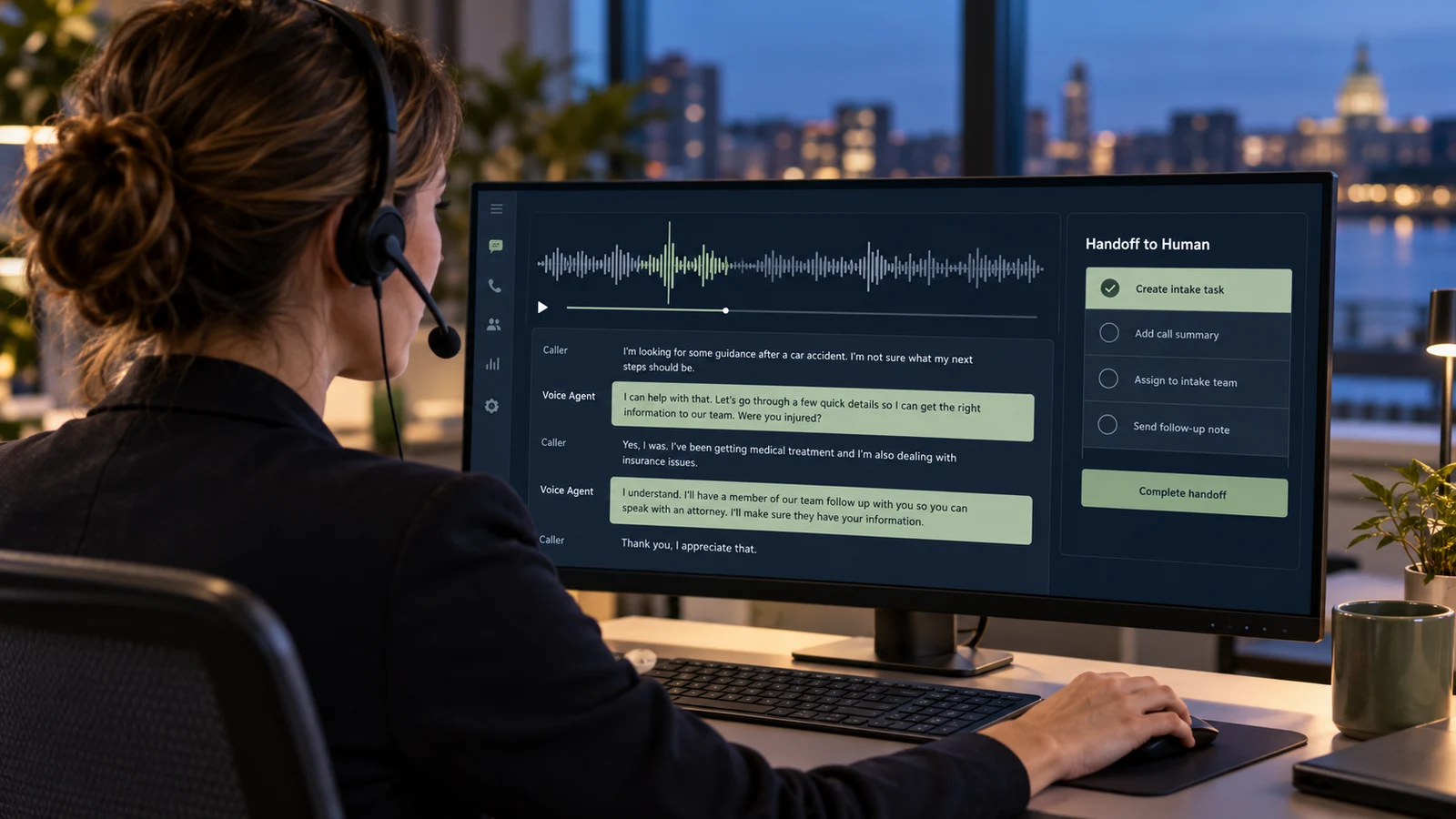
An after-hours caller describes a collision, corrects a phone number, asks whether the firm can help, and then requests a person. A convincing voice is useful. A correct record, an available human, and an owned next action determine whether the firm can act on the inquiry. We evaluate Bland AI and ElevenAgents against that complete sequence.
Gadient Consulting designs, deploys, and manages AI intake workflows for law firms. We define the permitted conversation, connect approved systems, test failures, train the receiving team, and review the operation after launch. For established personal injury firms, the buying decision is which configuration can reliably support the firm’s intake process at an acceptable total cost.
Our decision rule: eliminate any configuration that cannot preserve corrected information, respect attorney-review boundaries, and recover from a failed handoff. Among configurations that pass, compare client experience, staff rework, and cost per completed task. This article combines vendor documentation checked October 18, 2026 with Gadient’s implementation process; the pilot criteria below are an evaluation tool, not published head-to-head results.
Bland AI versus ElevenAgents, with the right ElevenLabs model.
Bland AI and ElevenAgents are voice-agent platforms. Eleven v4 is a speech model, not the complete intake application. ElevenLabs’ current model documentation lists Eleven v4 and Eleven v4 Turbo. Its selection guide identifies v4 Turbo for conversational agents; the listed model identifier is eleven_v4_turbo. We record the exact model, voice, language, agent version, and carrier path used in the pilot so that a later configuration change does not invalidate the comparison.
ElevenLabs describes v4 Turbo as expressive real-time synthesis and reports approximately 100 milliseconds of median inference latency, excluding application and network latency. That is a vendor specification for one component. It does not mean a caller hears an answer 100 milliseconds after finishing a sentence. Telephone transport, speech recognition, turn detection, language-model processing, tool calls, and playback all affect the experience.
We confirm that the required voice model is selectable in the purchased agent configuration before contracting around it. We then test over the actual phone route. A studio-quality voice sample and a browser conversation do not establish telephone performance.
The side-by-side buying matrix.
The matrix separates documented product mechanisms from the work required to make them useful in a PI firm. “Test” means a purchasing acceptance requirement. It does not imply that Gadient has completed a comparative trial or that either vendor guarantees the result.
Source: Bland Conversational Pathways
Source: Bland Enterprise warm transfer
Source: Bland current pricing
Source: Bland Outcomes
Source: ElevenAgents conversation-flow controls
Source: ElevenAgents tools
Source: ElevenAgents transfer to number
Source: ElevenAgents platform overview
Source: ElevenAgents retention settings
Source: ElevenAgents per-agent Zero Retention Mode
Source: ElevenAgents pricing and external costs
Swipe or scroll the table sideways to view every column.
| Decision area | Bland AI | ElevenAgents | What we require |
|---|---|---|---|
| Voice and emotional delivery | Evaluate the selected Bland voice on the firm’s scripts. | v4 Turbo is documented for expressive conversational use. | Score calm delivery, pronunciation, and appropriateness with the same callers; no presumed winner. |
| Interruptions and pacing | Pathways includes a Wait for Response node; verify interruption behavior in the chosen configuration. | Conversation-flow controls cover interruptions, turn eagerness, silence and timeouts. | Caller can correct an answer without a repeated script or lost correction. |
| Telephone latency | Measure the deployed telephone route. | Measure the deployed route; do not substitute the v4 Turbo synthesis specification. | Record median and slow-tail response delay, including tool-dependent turns. |
| Workflow control | Conversational Pathways provides nodes, branching and webhooks. | Tools call external APIs; conversation-flow settings govern turn behavior. | Required questions, exception states and completion rules are explicit. |
| Human handoff | Enterprise warm transfer documents a human briefing, call merge, timeout and fallback handling. | Native Twilio conference transfer supports a human briefing; SIP transfers do not support that warm message. | Prove human connection, context delivery and no-answer recovery on the purchased plan. |
| CRM and matter systems | Webhook nodes can exchange data with an authorized endpoint. | Webhook tools can call authorized external APIs. | Verify each connector and field mapping; an API is not a native Clio, Filevine or Litify integration. |
| Monitoring | Call data and Outcomes rules support outcome review; verify plan access. | Platform materials describe monitoring and evaluation. | Reconcile call records to the actual assigned task, then review exceptions. |
| Data handling | Verify retention, deletion, access and export terms for the exact contract; Enterprise lists additional controls. | Agent retention controls and per-agent Zero Retention Mode are documented. | Approve the whole data path, including carrier, CRM and our review workflow. |
| Operating cost | Platform and usage charges, transfer rules and carrier costs. | Plan/minute charges, separate LLM usage, carrier costs and possible burst usage. | Add integration maintenance, human review and failed-task recovery. |
Documentation-based comparison and Gadient purchasing criteria, checked October 18, 2026. These are not measured performance scores.
We start with an after-hours operating brief.
Before configuring a voice, we inspect the call route and the work that follows it. We document business hours, time zones, overflow rules, current answering coverage, approved intake questions, source capture, escalation contacts, appointment availability, and the system that owns the inquiry. A firm serving multiple states needs an explicit routing and attorney-review map, not a single generic script.
The firm’s supervising attorney approves the question set, process answers, emergency language, and matters requiring legal judgment. The intake supervisor owns staffing, callback coverage, and completion of assigned work. Gadient owns the scoped configuration, integration tests, monitoring setup, and improvement queue. The agreement names who fixes carrier or CRM failures and who can pause the agent.
We limit the first deployment to a defined after-hours route. The agent collects initial information, answers approved process questions, and routes or schedules within the available permissions. It does not independently accept or reject cases, give legal advice, or promise representation. Broader business-hours overflow comes only after the firm has evidence that the route and receiving team can handle the workload.
- Deliverable: workflow map with ordinary, exception and fallback paths.
- Deliverable: approved question set, field dictionary and answer boundaries.
- Deliverable: permissions register, human coverage roster and pause procedure.
- Deliverable: pilot scorecard, release checklist and named operational owners.
Connect the work to our AI agent implementation and management service.
What we configure when a caller needs a person.
Consider this illustrative operating scenario: a caller reaches the firm after hours about a motor vehicle collision, gives an incomplete account, corrects a callback number, and asks to speak with someone. We configure the agent to acknowledge the request and stop pursuing the remaining question list when a human handoff is appropriate. A missing answer stays unknown; the agent must not infer it to finish a form.
Before routing, the workflow preserves the corrected number, caller-provided facts, unanswered questions and transfer reason. It attaches the call identifier and available marketing-source evidence to the inquiry. The receiving staff member gets the information needed to continue the conversation without requiring the caller to restart. Access to the full transcript is restricted to the people who need it.
If no approved staff member is available, the workflow follows the firm’s agreed fallback. That can mean a callback task with an owner, backup, priority and due-time rule. We test the path the carrier and platform actually support rather than assuming a disconnected transfer can be recovered by a prompt. The caller receives an accurate explanation of the next step, with no unsupported response promise.
Completion requires evidence from the receiving system. A successful webhook response alone is insufficient if it did not create the expected record or assign an owner. We reconcile the inquiry identifier and task status, and flag any unresolved write or transfer for human action. The firm’s intake team closes the task only when the required follow-up is complete.
Warm transfer is a configuration and coverage decision.
Bland’s warm-transfer documentation describes an Enterprise feature that briefs a human on a separate call and then joins the caller. It also documents hold timeouts and fallback handling when a person cannot be reached. We scope that feature explicitly rather than assuming it is included in a lower-priced self-service plan.
ElevenAgents documents different transfer mechanisms. Its native Twilio conference-transfer route supports an agent_message for briefing the receiving person. SIP transfers do not support that warm-transfer message. A firm using SIP must therefore evaluate a different context-delivery method and verify it in the receiving team’s workflow.
We test an answered call, busy destination, voicemail, an unavailable staff member, an extension tree, and a carrier failure. A dial attempt is not a successful handoff. Our acceptance record distinguishes “human connected and context available” from “fallback task accepted” and “unresolved.” A platform may fit the firm on one telephone configuration and fail the requirement on another.
Source: Bland Enterprise warm transfer
Source: ElevenAgents transfer to number
We connect records without turning an API into a compatibility promise.
Bland documents webhook nodes within Pathways. ElevenAgents documents webhook tools that call external APIs. Those mechanisms support custom integration work, but they do not establish that every action in the firm’s CRM or case-management system is available on its current subscription.
We inventory the specific operations: find or create an inquiry, check for an existing record, save corrected fields, attach a call reference, assign a task, and request or confirm a consultation slot. For each operation we verify API permissions, required fields, rate limits, validation, and the responsible system. We distinguish a documented native connector from custom middleware and from an operation that is not supported.
We use a stable call or inquiry identifier to prevent retries from creating duplicate records. Corrections update the authoritative field while preserving an audit trail where supported. Failed writes enter an exception queue; the agent must not tell a caller an appointment is confirmed if the calendar did not accept it. The integration handover includes field mappings, retry rules, service-account ownership and a test showing the next person can actually find the work.
Source: Bland Conversational Pathways
Source: ElevenAgents tools
Define record ownership with the intake CRM versus case management guide.
A fair pilot uses the same difficult conversations.
We create a fixed scenario set before comparing vendors. Both configurations receive the same approved questions, answers, routing policy, synthetic caller facts and target system. We document model versions and test conditions, randomize the order of the calls, and keep failed or abandoned attempts in the record. We use authorized test numbers rather than placing unannounced test calls to real prospects.
The acceptance plan begins with critical failures: invented legal answers, unauthorized disclosure, a lost corrected phone number, or an unowned failed handoff blocks release until corrected and retested. The firm sets numerical thresholds for noncritical quality, delay and cost before reviewing results. One successful demonstration cannot establish reliability across languages, accents, carrier conditions or call surges.
We score ordinary intake and difficult paths separately. This prevents many easy calls from hiding a repeated escalation defect. We then pilot limited live traffic only after the firm approves the controls, with human coverage available and an immediate route-back option.
Swipe or scroll the table sideways to view every column.
| Scenario | Expected behavior | Evidence to retain |
|---|---|---|
| Distressed or interrupted caller | Pause appropriately, acknowledge corrections, offer the approved human route. | Recording where authorized, transcript flags and reviewer score. |
| Corrected phone number or incident detail | Read back as appropriate and preserve the final corrected value. | Expected value versus saved CRM field. |
| Ambiguous answer or request for legal advice | Keep unknown facts unknown; route the decision to the firm. | Escalation reason and receiving owner. |
| Staff unavailable or transfer fails | Use the tested fallback without a false promise of connection. | Carrier outcome plus accepted callback task. |
| CRM or calendar unavailable | Avoid false confirmation; record the exception for recovery. | Failure log, retry result and task reconciliation. |
| Repeated webhook or callback | Prevent duplicate records and unnecessary repeat outreach. | Stable identifiers and duplicate check. |
Proposed same-scenario pilot checklist. Use synthetic or expressly authorized materials; no client transcripts are published.
Prepare the operating requirements with our PI firm AI readiness checklist.
We measure completed work and the effort behind it.
Our scorecard keeps task quality separate from sales outcomes. A call can be handled correctly and still concern a matter the firm does not want. We do not credit the voice agent with a signed case merely because it answered the phone. Marketing source, attorney-approved fit, retainer completion and downstream matter status remain separate fields.
For each pilot report we record the dates, configuration version, call count, scenario selection, language mix and missing observations. We show counts beside percentages and report technical failures rather than removing them. The pilot sample establishes readiness for the tested scope, not a national PI benchmark.
Swipe or scroll the table sideways to view every column.
| Metric | Definition | Management action |
|---|---|---|
| Question completeness | Correctly captured applicable required fields / applicable required fields in reviewed calls. | Repair the specific question, extraction or confirmation step. |
| Human handoff success | Required handoffs with confirmed human connection and usable context / all required human handoffs. | Fix routing, carrier behavior or staffing; report fallback outcomes separately. |
| Staff rework | Human minutes spent correcting and completing agent-created tasks / reviewed tasks. | Simplify fields or narrow the automation scope. |
| Response latency | Elapsed time from caller turn ending to audible response, with tool and non-tool turns separated. | Inspect turn detection, model and tool delays; report median and 95th percentile. |
| Unnecessary repetition | Reviewed calls containing an unnecessary repeated question / all reviewed calls. | Correct memory or branching behavior; distinguish intentional read-back. |
| Cost per completed task | All included operating costs / tasks meeting the agreed completion rule. | Compare the accepted output to the staffed alternative. |
Gadient measurement definitions. Targets are agreed for the firm and task before rollout; these are not claimed improvement rates.
Daily review turns a voice agent into a managed service.
Gadient builds additional AI review bots that analyze call transcripts daily for missed intake questions, repetitive agent behavior and sentiment signals. The review produces flagged exchanges, evidence and recommendations. A human evaluates the findings and approves changes before they reach the voice agent.
We separate a questionable agent response from a transcription mistake or a caller changing their answer. Sentiment is an imperfect signal for review, not a definitive judgment about the caller. The human reviewer checks the surrounding exchange and, when permitted, the recording. We also inspect a sample of unflagged calls so that a blind spot in the review bot does not become invisible.
Approved changes update the agent’s instructions, knowledge or workflow configuration as applicable. We record the reason and version, rerun the affected scenario tests plus core regression cases, and monitor subsequent calls for the intended behavior and new defects. This refines the deployed agent; it is not a claim that we retrain a vendor’s underlying model.
The intake supervisor owns callback and handoff exceptions each day. Gadient manages the scoped quality review and technical change queue. A weekly operating review examines recurring errors, staff rework, costs and client-experience indicators. Material failures trigger immediate escalation and can pause the affected route. The monthly leadership review decides whether to expand hours, change coverage, fund an integration repair or reduce the automated scope.
Source: Bland Outcomes
Source: ElevenAgents platform overview
Retention settings must match the review operation.
ElevenAgents documents configurable transcript and audio retention, as well as per-agent Zero Retention Mode. Its retention documentation currently states a two-year default. We inspect and deliberately configure the actual account rather than treating the default as the firm’s policy. Zero retention changes what evidence remains available for troubleshooting and ongoing quality review.
For Bland, we request the current retention, deletion, access, export and subprocessor terms for the contracted configuration. Its pricing materials list Enterprise controls such as SSO and data-residency options, but a feature list is not a finding that a particular firm’s use meets all of its obligations.
The firm approves which information may be collected, who can access recordings and transcripts, and how long each system retains them. The carrier, agent platform, CRM, integration logs and our review system can each hold a copy. We map that chain, minimize what moves between systems, and test removal of access. Recording, disclosure and consent requirements go to the firm’s counsel before launch. No agent has unrestricted access to all matters simply because the integration supports a broad credential.
Source: ElevenAgents retention settings
Source: ElevenAgents per-agent Zero Retention Mode
Source: Bland current pricing
Price the complete task, not the advertised minute.
As checked October 18, 2026, Bland’s pricing page lists Start at $0.14 per talk minute with no platform fee, and Build at $299 per month plus $0.12 per talk minute. Listed transfer rates are $0.05 and $0.04 per minute respectively; the page distinguishes bring-your-own-telephony transfer treatment and separate carrier costs. Enterprise pricing is custom. Obtain a configuration-specific quote when warm transfers or additional controls are required.
ElevenAgents’ current pricing page lists plan-based included call minutes, additional call minutes at $0.08, and burst minutes at $0.16 when applicable. LLM usage is separate and depends on the model; external carriers bill their own charges. An overage rate is not the entire price of operating an intake service. Confirm the current plan allowance, model charges, concurrency and transfer treatment for the planned route.
Our cost worksheet includes platform subscription, used and unused included capacity, overage, carrier and number charges, LLM charges where applicable, integration hosting, transcript review, human fallback and ongoing management. We separately show initial setup costs and recurring costs. We allocate setup across an explicitly stated planning period rather than hiding it in a cheap-looking minute rate.
For an illustrative calculation, suppose the monthly operating total is $1,200 and 300 tasks meet the completion rule. Cost per completed task is $4. If only 200 tasks qualify with the same spend, it becomes $6. Those inputs are hypothetical, not product pricing or a client result. The calculation shows why errors and unfinished handoffs can matter more than a small difference in minute rates.
Source: Bland current pricing
When each platform deserves the next test.
We shortlist Bland when the firm’s requirements align with a node-based telephone workflow and its purchased transfer, infrastructure and support options. We shortlist ElevenAgents when configurable conversational behavior, a documented voice-model choice and its available tool and telephone paths fit the operating brief. These are fit hypotheses to test, not a universal ranking.
The strongest objection to either choice is straightforward: a capable answering team plus a repaired follow-up queue may solve the problem with less complexity. If the firm cannot staff the escalation path, authorize system access, maintain knowledge or fund review, adding an AI voice can create more unfinished work. We address those prerequisites before directing calls to it.
We expand only when the tested configuration meets the agreed critical controls and shows acceptable completion, review effort and full cost. Otherwise we correct the narrow failure, keep the route limited or retain human coverage. The comparison should end in a scope and ownership decision, not a trophy for the most natural voice.
What the firm receives from Gadient.
Our implementation engagement produces the operating brief, workflow and permission maps, approved agent configuration, verified system handoffs, pilot acceptance record, team guidance and management scorecard. Ongoing management covers transcript quality review, integration failures, knowledge updates, approved releases and usage costs within the agreed scope.
Bring the current phone route, intake question set, coverage schedule and system list to the consultation. We identify the first controllable workflow and the evidence needed to approve it. The goal is a caller who reaches the right next step and a firm that can see who owns the work.
Scope the workflow: request a conversation with Gadient Consulting.

ABOUT GADIENT CONSULTING
Founded by Nick Gadient, Gadient Consulting provides fractional CMO leadership for law firms, connecting marketing strategy, agencies, budget, and intake.
Meet Nick